
The Raven
Basic facts
“The Raven” is a narrative poem by the American writer, poet, editor, and critic Edgar Allan Poe. It was first published in the New York Evening Mirror on January 29, 1845. Combining Gothic atmosphere, lyrical intensity, dramatic narration, and elaborate sound patterns, the poem became one of the most recognizable works in American literature. Its fame rests not only on its supernatural suggestion, but also on the precision with which it turns a small nocturnal incident into a study of grief and mental disintegration.
Plot and structure
The unnamed narrator sits alone in his chamber on a cold December night, attempting to distract himself from the death of his beloved Lenore by reading. As he is nearly asleep, he hears a soft knocking at the door. He imagines that a visitor may be there, then tries to explain the sound as something ordinary. When he opens the door, however, he finds only darkness. The emptiness outside intensifies rather than relieves his anxiety.
A second disturbance comes from the window. When the narrator opens it, a raven enters and settles upon a bust of Pallas, the figure associated with wisdom. The narrator jokingly asks the bird its name and is startled when it answers, “Nevermore.” The word may be merely a phrase the bird has learned to repeat, yet the narrator gradually treats it as an authoritative response to his deepest fears. He connects it with the departure of friends, the disappearance of hope, and finally the possibility of seeing Lenore again in an afterlife. Each question becomes more desperate, while the answer remains unchanged.
At the poem’s close, the narrator demands that the bird leave him and his chamber. The raven remains perched above him, and the light casts its shadow upon the floor. The narrator feels that his soul is trapped within that shadow and will never be lifted. Poe leaves the raven’s status unresolved: it can be a supernatural messenger, a symbol of death, an accidental bird repeating a memorized word, or an embodiment of the narrator’s own grief. The uncertainty allows the external scene and the inner crisis to become indistinguishable.
Themes and technique
The poem’s central subject is mourning that cannot reach an ending. Lenore is dead, but the narrator repeatedly summons her through questions, reopening the wound each time. “Nevermore” functions both as the raven’s limited reply and as the destructive conclusion the narrator forces upon himself. He knows that the word will not change, yet he continues asking increasingly painful questions. Grief therefore appears not as passive sadness but as a process of compulsive self-torment.
The raven carries several possible meanings. It suggests death, ill fortune, and the supernatural, while also retaining the ordinary physical presence of a bird that can only repeat a learned phrase. The bust of Pallas places the creature above an emblem of reason and wisdom, creating an image of intellect overwhelmed by fear and sorrow. The door and window are thresholds between the private chamber and the outer world, and perhaps between life and death. Midnight, darkness, and the final shadow reinforce the narrator’s sense that he has crossed into a psychological enclosure from which he cannot return.
Poe’s sound effects are essential to the poem’s power. Internal rhyme, alliteration, recurring refrains, and carefully controlled rhythm give the stanzas an incantatory, almost mechanical resonance. The repeated answer first seems curious, then ominous, and finally absolute. The action moves from a faint knock to curiosity, fear, questioning, and spiritual imprisonment. Beautiful musical form and unbearable emotional content are held together rather than separated, creating the distinctive tension that makes the poem memorable.
Background and lasting influence
Poe supported himself through the nineteenth-century magazine and newspaper world, working as a writer, editor, and literary critic as well as a poet. He argued that a successful short work should be deliberately constructed to produce a unified effect. “The Raven” exemplifies that principle: its setting, repetitions, images, and steadily narrowing exchange all contribute to melancholy and terror. Poe later discussed the poem’s construction in “The Philosophy of Composition,” presenting its effects as the result of conscious artistic design. Whether that account is entirely retrospective or not, it helped establish a lasting critical interest in the poem’s formal architecture.
The poem was initially rejected by Graham’s Magazine before finding publication, and its appearance in 1845 quickly brought Poe national attention. Its unusual rhythm, theatrical voice, and haunting refrain inspired numerous imitations during Poe’s lifetime and afterward. The raven, the dark chamber, the bust of Pallas, and the shadow on the floor have become enduring visual and cultural symbols, reproduced in illustration, translation, performance, and adaptation.
Today, “The Raven” stands as a major text of American Romanticism and Gothic literature, as well as a model for studying sound, repetition, unreliable perception, and the psychology of mourning. It helped secure Poe’s reputation as a master of atmosphere and verbal technique, while its influence extends into Symbolist poetry, horror fiction, popular culture, and visual art. Its lasting achievement is to transform one grieving man’s inability to accept loss into an experience that readers can hear, imagine, and repeatedly undergo through language.
About the Author
Early life and education
Edgar Allan Poe was born Edgar Poe in Boston, Massachusetts, on January 19, 1809. His parents, David Poe Jr. and Eliza Arnold Poe, were traveling actors. His father abandoned the family when Edgar was very young, and his mother died of illness in 1811. Edgar was taken in by John and Frances Allan of Richmond, Virginia. John Allan was a prosperous tobacco merchant, but his relationship with the boy was frequently strained. Poe adopted “Allan” as a middle name, although he was never formally adopted. The repeated experiences of separation, uncertain belonging, and bereavement became important contexts for his imagination, even though his literary characters cannot simply be equated with his biography.
The Allan family lived in Britain for several years, and Poe received part of his education there between 1815 and 1820. After returning to Richmond, he continued at private schools and studied languages, including Latin and French. He also showed an early interest in poetry, drama, swimming, and other physical activities. In 1826 he entered the University of Virginia, but his attendance was brief because of financial difficulties and worsening conflict with his foster father. In 1827 he published Tamerlane and Other Poems at his own expense, beginning the literary career that would eventually make him internationally famous.
Military service and professional writing
In 1827 Poe enlisted under the name Edgar A. Perry. He later entered the United States Military Academy at West Point, but left after conflicts involving discipline and his obligations. By 1831 he had turned decisively toward literary work. He moved among Richmond, Baltimore, Philadelphia, and New York, earning money through magazine writing, editing, and criticism. Periodical publishing offered him access to readers, but it also left him with an unstable income and a difficult professional life.
His story “MS. Found in a Bottle” won recognition in 1833. In 1835 he joined the Southern Literary Messenger, where his reviews established him as an exacting and sometimes combative critic. In 1836 he married his cousin Virginia Clemm. Poe continued to write poetry, fiction, and criticism while trying to reconcile artistic ambition with the demands of magazine employment and financial insecurity.
Major works
Poe’s major works cross several genres. The Narrative of Arthur Gordon Pym, published in 1838, combines maritime adventure, terror, illusion, and mystery. “The Fall of the House of Usher,” published in 1839, became a defining Gothic tale through its decaying mansion, troubled family, and atmosphere of psychological dread. “The Murders in the Rue Morgue” appeared in 1841 and introduced C. Auguste Dupin, a detective whose analytical method helped establish the modern detective story.
“The Tell-Tale Heart,” published in 1843, explores guilt and distorted perception through an unstable narrator. “The Gold-Bug,” also published in 1843, uses cryptography, treasure, and deduction. “The Raven” appeared in 1845 and brought Poe broad public recognition through its musical language, theatrical setting, and study of grief. Other important works include “The Cask of Amontillado,” “The Philosophy of Composition,” and the poem “Annabel Lee,” which appeared in 1849. His criticism repeatedly emphasized construction, style, and the unified effect a work produces on its reader.
Final years and reputation
Virginia Poe died in 1847, a loss that deepened the sorrow surrounding Poe’s later years. It also encouraged later readers to identify his poems about dead beloveds directly with his private life, though a careful biography distinguishes emotional experience from literary transformation. Poe continued to write, lecture, and seek editorial opportunities, but his health, finances, and professional circumstances remained precarious.
He died in Baltimore, Maryland, on October 7, 1849, at the age of forty. The precise circumstances of his final illness and death have remained uncertain, allowing legend to grow around his last days. His reputation during his lifetime was mixed, and some judgments about his personality and habits were hostile or reductive. After his death, however, his importance became increasingly clear.
Poe is now regarded as a major American Romantic and Gothic writer, a pioneer of the modern short story and detective fiction, and an early contributor to science fiction. His command of atmosphere, psychological narration, formal pattern, and critical theory influenced the French Symbolists and generations of writers in horror, crime, fantasy, and speculative fiction. “The Raven,” the Dupin tales, and “The Fall of the House of Usher” have made him a lasting figure in world literature, associated with the meeting of rational analysis, supernatural suggestion, and the beauty of despair.
StoryFlow
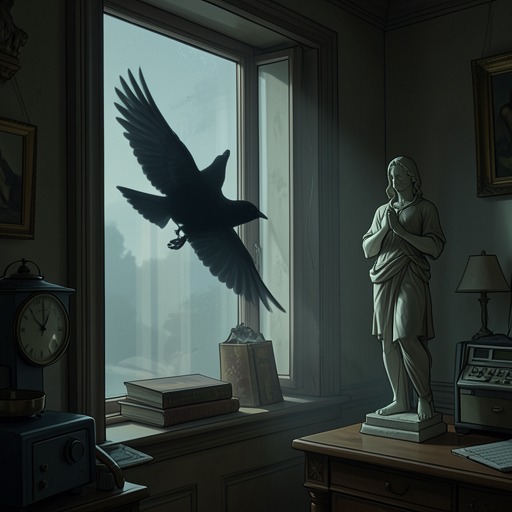
The Raven’s Occupation of the Chamber
This flow follows how a small bird transforms from visitor into the governing presence of the narrator’s room.
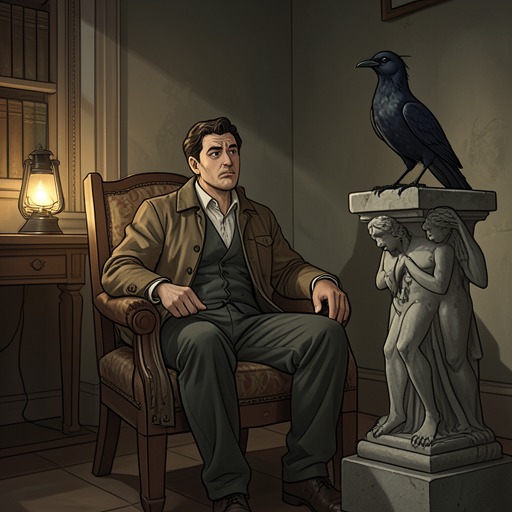
The Sequence of Questions
This flow follows the narrator’s changing questions as curiosity becomes accusation, prayer, and despair.
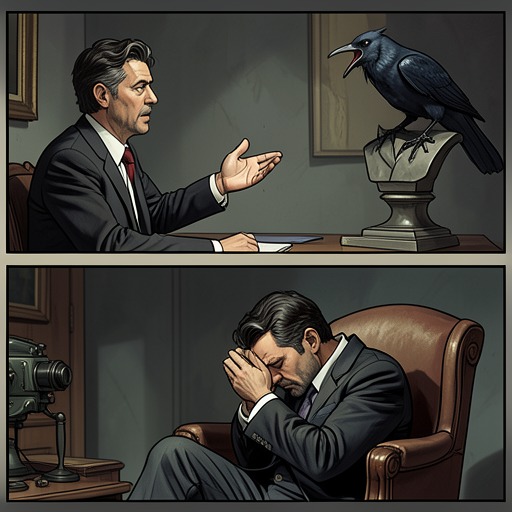
The Final Command
This flow traces the narrator’s failed effort to reclaim authority over the chamber and his own grief.
